

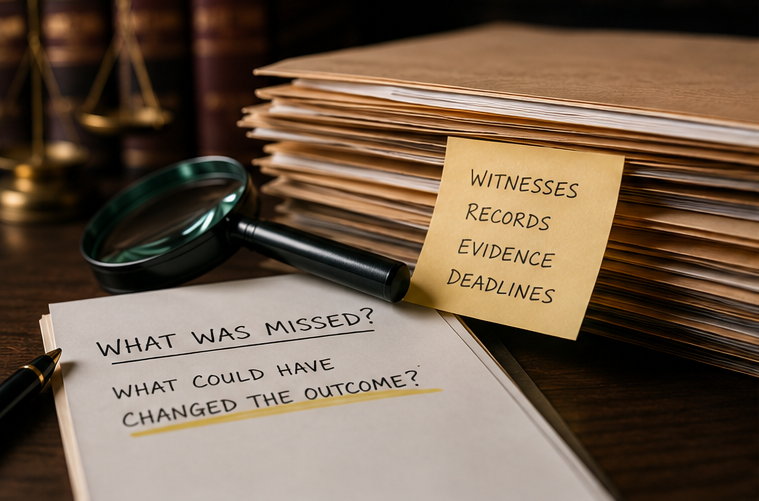
When your case ends badly, it is natural to look back and ask whether something important was missed.
Maybe your lawyer seemed unfamiliar with the facts. Maybe the questions you raised were never answered. Maybe important evidence, records, or witnesses were never fully discussed before major decisions were made.
A disappointing result does not automatically mean legal malpractice. Lawyers cannot guarantee outcomes, and some cases are difficult even when they are handled properly. But when a lawyer fails to investigate information that could have affected the value, strategy, or outcome of a case, the situation deserves a closer look.
The issue is not simply whether you lost, felt unhappy with the result, or later believed an agreed settlement was inadequate. Pennsylvania law generally does not permit a client to challenge an accepted settlement merely because the client believes a better result could have been obtained. The question is whether the former lawyer committed a separate professional error that caused measurable harm.
A Bad Outcome Does Not Always Mean Legal Malpractice
Legal malpractice in Pennsylvania requires more than frustration with a prior attorney.
To bring a claim, you generally need to show that an attorney-client relationship existed, that the lawyer failed to act with the skill and care expected of a reasonably competent attorney under the circumstances, and that this failure caused a measurable loss.
In many legal malpractice cases, that also means looking closely at the underlying case to determine whether the result likely would have been different if the attorney had handled the matter properly.
That distinction matters.
A lawyer can make a strategic decision that does not work out. A judge or jury can disagree with your position. An opposing party can have stronger evidence than expected. Those situations do not automatically mean your attorney committed malpractice.
The concern becomes more serious when a lawyer fails to investigate information that a reasonably careful attorney would have pursued.
If facts were available, witnesses could have been identified, records could have been requested, or evidence could have been preserved, the question becomes whether the failure to investigate damaged your underlying case.
What It Can Look Like When a Lawyer Fails to Investigate
Clients often come to me with the same uneasy feeling: “My lawyer never really looked into my case.”
That uneasy feeling can arise in many different ways. A prior lawyer may have failed to request medical records, business records, property documents, court filings, contracts, photographs, emails, text messages, police reports, expert opinions, or other important materials.
In some cases, the attorney may have known about a witness but never contacted that person. In others, the lawyer may have failed to identify all responsible parties before deadlines passed.
In a personal injury case, poor investigation can mean failing to document the full extent of the injury, missing evidence about fault, or overlooking available insurance coverage. In a real estate dispute, it can mean failing to review deeds, closing documents, title issues, communications, or property records. In other cases, it can mean failing to understand important facts before advising you to withdraw a claim, accept a legal consequence, or move forward in court. Settlement-related malpractice claims are subject to additional restrictions under Pennsylvania law, particularly when the client agreed to the settlement.
What matters is not whether the lawyer investigated every possible issue or chased every lead. The question is whether the lawyer failed to investigate something important enough that it affected the value, strength, or outcome of the case.
Why Investigation Matters Before Settlement, Mediation, or Trial
A case cannot be properly evaluated without facts.
Before a lawyer recommends settlement, prepares for mediation, files motions, responds to discovery, or goes to trial, the lawyer needs to understand the evidence. That means knowing what supports your position, what weakens it, what is missing, and what still needs to be developed.
When an investigation is incomplete, the client can be placed at a serious disadvantage. You may be advised to make decisions without a complete understanding of the claim’s strengths, weaknesses, risks, and value. You may lose the chance to pursue a responsible party, lose access to evidence that could have supported your claim, or walk into a hearing, mediation, or trial with a case that was never fully prepared.
That is why I focus closely on the timeline. I want to know what the lawyer knew, when the lawyer knew it, what information was available, what steps were taken, what was ignored, what deadlines applied, and what happened because the investigation was incomplete.
Those questions help determine whether the problem was simply a difficult case or whether the prior attorney’s conduct created avoidable harm.
Warning Signs Your Case Was Never Fully Investigated
Some warning signs are obvious. Others only become clear after another attorney reviews the file.
You may have reason to ask questions if your former lawyer rarely discussed evidence with you, never asked for key documents, failed to follow up on witnesses, seemed unaware of important facts, or could not explain the strategy behind major decisions. You may also be concerned if the attorney waited until the last minute to prepare, failed to preserve evidence, ignored information you provided, or gave advice before reviewing the records needed to evaluate the case.
Another warning sign is a result that seems disconnected from the facts you believed mattered. That does not prove malpractice by itself. But it can be a reason to examine whether those facts were ever presented, developed, supported, or used properly.
Legal malpractice claims are not built on suspicion alone. They are built on records, timelines, documents, testimony, and proof of what should have been done differently.
How a Pittsburgh Legal Malpractice Attorney Reviews a Failure to Investigate
I am Elizabeth M. Tarasi of Tarasi & Tarasi P.C. When I approach a possible legal malpractice claim involving a failure to investigate, I start with the record, not assumptions.
That review can include the original case file, pleadings, correspondence, court orders, discovery, settlement communications, expert materials, deadlines, witness information, and the outcome of the case. I also look at what evidence existed at the time, what the lawyer did to obtain it, and whether the missing investigation likely affected the strategy, available options, value, or outcome of the case.
That last point is critical because, in Pennsylvania legal malpractice cases, it is usually not enough to show that the lawyer made a mistake. You also need to show that the failure caused harm. In many cases, that means examining the underlying case and asking what likely would have happened if the attorney had handled the investigation properly.
This is sometimes the most difficult part of the claim. It requires more than saying your lawyer should have done more. It requires showing how the missing work mattered.
Why You Should Not Wait to Ask Questions
If you believe your former lawyer failed to investigate your case, time matters. Important records can become harder to obtain. Witness memories can fade. Files can be incomplete. Legal deadlines can affect your options.
Pennsylvania professional liability claims can also involve procedural requirements, including a certificate of merit when the claim alleges that a licensed professional deviated from an acceptable professional standard. That is another reason to have the situation reviewed carefully before assuming you do or do not have a claim.
You do not need to know the legal answer before you call. You need to know that something feels wrong and that you want a serious review of what happened.
Talk to a Pennsylvania Legal Malpractice Attorney About What Was Missed
If you believe your lawyer failed to investigate your case, you should not have to guess whether that failure affected your legal rights.
At Tarasi & Tarasi P.C., I take these concerns seriously. My team and I look at what your former lawyer did, what was missed, what the record shows, and whether the failure to investigate caused real harm. My goal is to help you understand whether a bad result was simply disappointing or whether it may have resulted from professional negligence.
If you believe that your former lawyer ignored key facts, failed to pursue important evidence, or allowed your case to move forward without the investigation it reasonably required, contact Tarasi & Tarasi P.C. to learn more about your potential options under Pennsylvania law.
To discuss your concerns, fill out our contact form to schedule a consultation.
Disclaimer: The articles on this blog are for informative purposes only and are not a substitute for legal advice. Reading this blog does not create an attorney-client relationship. If you are seeking legal advice, please contact our law firm directly.